


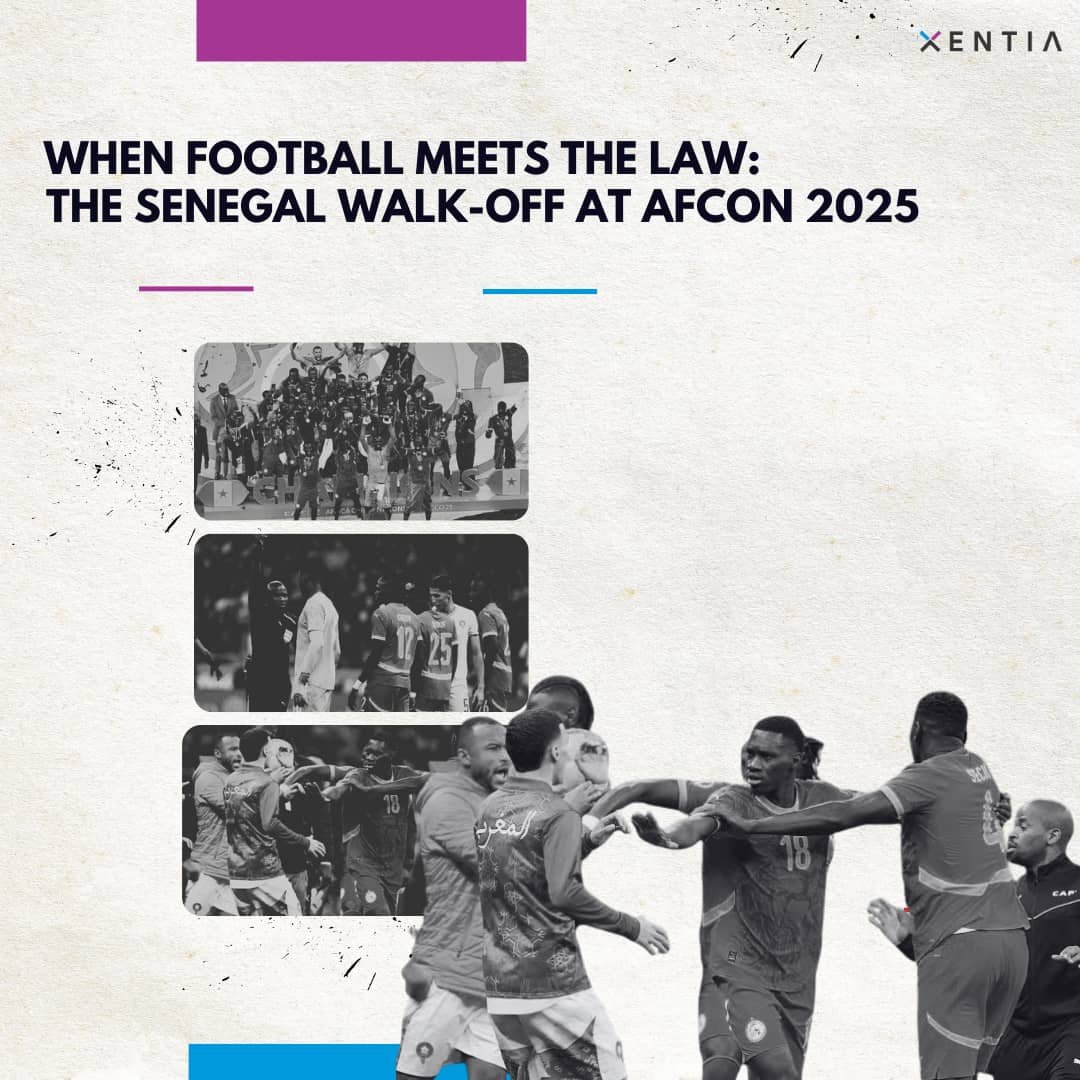
The 2025 Africa Cup of Nations final between Morocco and Senegal was supposed to be a celebration of African football at its best. Instead, it became a dramatic legal case unfolding on the pitch. A penalty awarded to Morocco after a VAR review sparked protests from Senegal, leading to a temporary walk-off, confrontations with security, and a CAF disciplinary review. While Senegal eventually returned and the match ended 1–0 in favor of Senegal, the incident raises questions far beyond the final whistle: how far can teams go in challenging referees, what responsibilities do players and coaches have, and how do football’s governing rules work when tempers flare?
This was more than a match; it was a moment where law and human behaviour collided in real time.
Rules, Authority, and the Limits of Protest
The Confederation of African Football’s disciplinary code is clear. Any team that leaves the field without the referee’s permission is considered to have abandoned the match. The consequences are serious. Forfeiture, fines, suspensions, and even exclusion from competitions are all on the table. Motive does not matter. Whether a team walks off in protest, frustration, or strategic calculation, the rules treat the act itself as a violation.
FIFA’s regulations echo this. Teams cannot decide on their own that a decision is unfair. Referees have ultimate authority, and VAR is designed only to assist them, not replace their judgment. Disputes over decisions must follow formal channels. The rules exist to ensure that football is played within an ordered, predictable system, even when emotions run high.
The Moment That Changed the Game
The pivotal incident came in the 98th minute. A VAR review led the referee to award Morocco a penalty. Senegal’s coach instructed his players to leave the field. Tensions erupted in the stands as some fans tried to invade the pitch. Several players headed toward the locker rooms, and for a tense few minutes, it was unclear if the match would continue.
From a legal standpoint, Senegal had already committed a disciplinary infraction the moment players stepped off the pitch. Their later return prevented the harshest penalty, i.e. automatic forfeiture but it did not erase the act itself. CAF can still apply intermediate sanctions, ranging from fines to suspensions or official warnings, to ensure accountability.
Referees, VAR, and Human Judgment
The incident highlights the delicate balance between human authority and technology in football. The referee’s power is absolute on the field. VAR exists only to advise. In this match, the referee’s hesitation to discipline the coach and players promptly amplified the problem. Even more, video footage suggested that Senegal’s goalkeeper may have breached Law 14 regarding the penalty, but the referee ended the match without corrective action. Legally, referees, VAR teams, and CAF all share responsibility to enforce the rules consistently, and lapses may lead to later review.
Who Bears Responsibility? Players, Coaches, and Federations
It is not just the team’s actions that matter; the conduct of technical staff and national federations plays a critical role. Players who make provocative gestures and coaches who incite protests fall under CAF’s disciplinary scope. Articles 146 and 147 of the CAF code provide grounds for action against anyone who undermines the integrity of a match.
Supporters’ behavior also falls into this framework. Attempted pitch invasions are both criminal offenses under local law and violations of sporting regulations. National federations are expected to anticipate and manage the risks posed by fans, including travel restrictions or stadium bans when necessary. The Senegalese federation may be held accountable to some degree for how the crowd behaved.
What Happens Next: Discipline and Appeals
CAF has a structured process to handle incidents like this. Immediate review can result in sanctions, and teams can appeal within CAF’s judicial bodies. FIFA oversees these processes to ensure global compliance, and ultimately, if disputes remain unresolved, the Court of Arbitration for Sport provides a final forum for adjudication. These mechanisms exist to make sure penalties are applied fairly, proportionally, and in line with the rules, while preserving the integrity of the competition.
Lessons for African Football
Several lessons emerge from this episode. First, teams must understand that VAR is an aid, not a loophole to protest decisions. Second, violations are treated seriously at the moment they occur, regardless of what happens afterward. Third, federations must take responsibility for both players and fans, ensuring that discipline and security are managed proactively. Finally, every national association should be well-versed in procedural requirements to protect its interests and navigate appeals properly.
Conclusion
The AFCON 2025 final was a reminder that football is not only a game of skill and strategy but also of governance, regulation, and law. Senegal’s walk-off may have been temporary, but it left a permanent mark on African sports law. The episode illustrates the complex web of authority between referees, VAR, players, coaches, federations, and continental governing bodies.
More than anything, it shows that emotions on the field cannot override the rules that keep the sport fair, safe, and credible. For African football, the lessons are clear: knowledge of the rules, preparedness for disciplinary processes, and a commitment to integrity are as crucial as the goals scored on the pitch.